Friday, 27 January 2023

What are Difference Between Wi-Fi and Bluetooth


Wi-Fi and Bluetooth are both wireless communication technologies, but they are designed for different purposes and have different characteristics. Wi-Fi is used for high-speed internet and network connections, while Bluetooth is used for short-range wireless connections between devices such as phones, speakers, and headphones. Wi-Fi typically has a longer range and higher bandwidth than Bluetooth, but Bluetooth is generally less power-intensive and can be used with a wider variety of devices.


How Wi-Fi Works


Wi-Fi works by using radio waves to transmit data between devices. A Wi-Fi network is typically made up of a router, which connects to the internet, and one or more devices, such as smartphones, laptops, or tablets, that connect to the router wirelessly.


The router sends and receives data using radio waves on a specific frequency, and each device on the network has a wireless adapter that can tune into that frequency and communicate with the router. Data is sent and received in packets, which are small units of information that can be reassembled into the original data on the receiving device.


When you connect a device to a Wi-Fi network, the device and the router negotiate a connection using a protocol called Wi-Fi Protected Access (WPA or WPA2) to establish a secure connection and to exchange a unique key to encrypt the data being transmitted.


In summary, Wi-Fi uses radio waves to transmit data between devices and a router over a specific frequency, and it establishes a secure connection using a protocol like WPA or WPA2 to encrypt the data being transmitted.


How Bluetooth Works


Bluetooth is a wireless communication technology that allows devices to connect and communicate with each other over short distances. It uses a low-power radio frequency to transmit data between devices, typically within a range of about 30 feet (10 meters).


When two Bluetooth devices want to connect, they go through a process called pairing. During pairing, the devices exchange information to identify each other and establish a secure connection. Once paired, the devices can communicate directly with each other, sending and receiving data such as audio or control commands.


Bluetooth technology is built on a protocol stack, which is a set of protocols that work together to enable communication. The main protocols include:


The Radio protocol, which handles the wireless communication over the radio frequency.

The Baseband protocol, which handles the connection and pairing process.

The Link Manager protocol (LMP), which handles link setup, management, and power control.

The Logical Link Control and Adaptation Protocol (L2CAP), which handles the segmentation and reassembly of data packets.

In summary, Bluetooth is a wireless technology that allows devices to connect and communicate with each other over short distances using a low-power radio frequency. It uses a protocol stack to handle the wireless communication, connection and pairing process, power control and segmentation and reassembly of data packets.


Types of Wi-Fi 


There are several different types of Wi-Fi, which are based on the IEEE 802.11 standard. Some of the most common types include:


802.11b: This is one of the oldest Wi-Fi standards and has a maximum data transfer rate of 11 Mbps. It operates on the 2.4 GHz frequency band.


802.11a: This standard has a maximum data transfer rate of 54 Mbps and operates on the 5 GHz frequency band. It is less prone to interference than the 2.4 GHz band.


802.11g: This standard has a maximum data transfer rate of 54 Mbps and operates on the 2.4 GHz frequency band. It is backward compatible with 802.11b.


802.11n: This standard has a maximum data transfer rate of 600 Mbps and operates on both the 2.4 and 5 GHz frequency bands. It uses multiple input, multiple output (MIMO) technology to improve performance.


802.11ac: This is the most recent Wi-Fi standard and has a maximum data transfer rate of 1.3 Gbps. It operates on the 5 GHz frequency band and uses MIMO technology for improved performance.


802.11ax: This is the latest Wi-Fi standard and has a maximum data transfer rate of 10 Gbps. It operates on both the 2.4 and 5GHz frequency bands and uses MIMO technology for improved performance and higher capacity.


Most of the current devices support the 802.11ac and 802.11ax, which are faster and more efficient than the older standards.


Types of Bluetooth


There are several different versions of Bluetooth technology, which are identified by a version number. Some of the most common types include:


Bluetooth 1.0 and 1.0B: These are the first versions of Bluetooth technology, which were released in 1999. They had a maximum data transfer rate of 1 Mbps and had a range of about 10 meters.


Bluetooth 2.0: This version was released in 2004 and had a maximum data transfer rate of 3 Mbps. It also introduced the Enhanced Data Rate (EDR) feature, which improved the speed and reliability of data transfer.


Bluetooth 2.1: This version was released in 2007 and introduced Secure Simple Pairing (SSP) for easier and more secure pairing of devices.


Bluetooth 3.0: This version was released in 2009 and introduced the High Speed feature, which allowed for faster data transfer using Wi-Fi.


Bluetooth 4.0: This version was released in 2010 and introduced the Bluetooth Low Energy (BLE) feature, which allowed for lower power consumption and longer battery life for devices.


Bluetooth 4.2: This version was released in 2014 and introduced Internet Protocol Support Profile (IPSP) which allows Bluetooth devices to communicate over IP networks, and also introduced Data Length Extension (DLE) which increases the maximum size of packets that can be sent over Bluetooth.


Bluetooth 5.0: This version was released in 2016 and introduced higher data transfer rates and longer range compared to previous versions. It also introduced the ability to transmit data over a longer distance and to multiple devices at the same time.


Bluetooth 5.2: This version was released in 2020 and introduced new features such as LE Extended Advertising and Angle of Arrival/Angle of Departure (AoA/AoD) which allows for more precise location tracking of Bluetooth devices.


The latest version of Bluetooth is Bluetooth 5.2, but most of the devices are using Bluetooth 5.0 or 4.2, which are widely supported and compatible with most devices. 

Saturday, 19 November 2022

A new cyber taskforce will supposedly ‘hack the hackers’ behind the Medibank breach. It could put a target on Australia’s back

Shutterstock
Mamoun Alazab, Charles Darwin University

The Australian government is launching an offensive against cybercriminals, following a data breach that has exposed millions of people’s personal information.

On November 12, Minister for Cyber Security Clare O'Neil announced a taskforce to “hack the hackers” behind the recent Medibank data breach.

The taskforce will be a first-of-its-kind permanent, joint collaboration between Australian Federal Police and the Australian Signals Directorate. Its 100 or so operatives will use the same cyber weapons and tactics as cybercriminals use, to hunt them down and eliminate them as a threat.

Details on how the taskforce will operate remain murky, partly because it needs to keep this information away from criminals. But the fact remains that taking an offensive stance, while it could deter further attacks, could also put a big red cross on Australia’s back.

Australia punches back

It was only in 2016 that the Australian government first publicly acknowledged it has offensive cyber capabilities housed in the Australian Signals Directorate – and that these are used against offshore cybercriminals. The admission came from then prime minister, Malcolm Turnbull, following attacks on the Bureau of Meteorology and Department of Parliamentary Services.

Australia has used cyber offensive strategies a number of times in the past. This has included operations against ISIS and, more recently, efforts to disable scammers’ infrastructure and access to stolen data at the start of the pandemic. Details of intelligence operations are generally kept under wraps, especially where the Australian Signals Directorate is involved.

How might the taskforce operate?

Minister O'Neil has said the new taskforce will:

scour the world, hunt down the criminal syndicates and gangs who are targeting Australia in cyber attacks and disrupt their efforts.

As to whether it could launch a counterattack on the Medibank hackers, the resources are there, but working out the kinks will be crucial. Australia’s intelligence agencies have more resources than the average organised cyber gang, not to mention connections to other advanced intelligence agencies around the world.

However, one key issue with holding cybercriminals to account is attribution. A legitimate counterattack requires identifying the source of an attack beyond reasonable doubt. The Medibank data leak has been attributed to criminals based in Russia – most likely from, or at least associated with, the REvil cyber gang.

This assumption is based on similarities between existing REvil sites on the dark web and the extortion site hosting the stolen Medibank data, as well as other similarities between the Medibank attack and REvil’s previous attacks.

That said, hackers can hide their identity by routing through (often unaware) third parties. So even if this attack is attributable to REvil, or its close associates, the attackers could easily deny involvement if taken to court.

The group could say its systems were used as unwitting hosts by another external perpetrator. Plausible deniability can almost always be maintained in such cases. Russia (and China) have had a track record of denying involvement in cyber espionage.

As such, it’s very difficult to prosecute cybercriminals – especially in cases where these criminals may be backed (officially or unofficially) by their government. And if perpetrators can’t be put behind bars, they can simply lie low for a while before popping up somewhere else in cyberspace.

Beyond the Medibank hackers, the taskforce will also target other potential threats to Australia. In the case of inaccurate attribution in any of these operations, we might see tit-for-tat escalation. In a worst-case scenario, attacks based on incorrect attribution could start a cyberwar with another country.

Defence before offence

By actively seeking and trying to neutralise offshore gangs, Australia will put a target on its back. Russian-linked criminal gangs and others might be encouraged to retaliate and target our sectors, including critical infrastructure.

Boosting Australia’s cyber defences should be the top priority – arguably more so than retaliating. Especially since, even if the taskforce successfully mounts a counterattack on the Medibank hackers, it’s unlikely to recover any data stolen (since criminals make copies of stolen data).

Going after cybercriminals addresses the symptoms of the problem, not the root: the fact that our systems were vulnerable enough to be hacked in the first place. The Medibank breach, and the major Optus breach preceding it, have both demonstrated that even businesses with seemingly strong cybersecurity protocols are vulnerable to attacks.

The best option from a rational and technical standpoint is to prevent, as much as possible, data being stolen in the first place. It might not be as flashy a solution, but it’s the best one in the longer term.The Conversation

Mamoun Alazab, Associate Professor, College of Engineering, IT and Environment, Charles Darwin University

This article is republished from The Conversation under a Creative Commons license. Read the original article.

Canada’s public broadcaster should use Mastodon to provide a social media service

Mastodon’s decentralized network could be leveraged as a model for future social media. (Shutterstock)
Fenwick McKelvey, Concordia University and Robert W. Gehl, York University, Canada

Elon Musk’s acquisition of Twitter and ensuing confusion has driven many to look for alternatives to the platform. One popular option has been Mastodon, a social network distributed on many servers with no central ownership.

Mastodon has seen its profile raised over the past few weeks, and user registration has skyrocketed. Mastodon is not one company, but many federated servers working together. These individual servers need resources. These resources should be public.

As internet communications scholars, we propose that Canada’s public broadcaster, the CBC, should build a Mastodon server on the global network.

CBC starting a Mastodon server could be the start of the news organization seeing itself as not just creating content online, but building better infrastructure for Canadians to create online.

ITV News explains why users are leaving Twitter for Mastodon.

Canadian social media

Mastodon is free and open-source social media software, available to anyone who wants to install it on a computer server. Once installed, a Mastodon server allows people to sign up for accounts and from there do familiar social media activities, such as sharing posts and following others.

What makes Mastodon powerful is that it’s part of a larger network of servers referred to as the fediverse. This network allows one Mastodon server to connect to another — as well as to many other social media software systems. The result is a large, non-centralized network of smaller servers.

So the CBC could use the Mastodon platform and build its own server to provide access to Canadians who want social media without the reliance upon predominantly American corporations. Ideally, this could be provided globally as an important service in an age when platform interests and national interests have increasingly aligned.

The future of public service media

In the past, the CBC has been a little sensitive about its social media strategy. When former CBC tech columnist Jesse Hirsh called out the public broadcaster for its over-reliance on Facebook, his spot ended.

His comments raise an awkward point: why does a public broadcaster rely so much on privately owned platforms to reach its audience?

The reason is that the work of running a social media service is a challenge for an organization mostly dedicated to content production. But that’s not always been the case.

Historically, Canada’s publicly funded media has many great examples of thinking beyond content production. The National Film Board’s Challenge for Change program sent filmmakers to document the lives of Fogo Island residents. CBC’s ZeD was an experiment in open-source television — the long-forgotten platform allowed Canadians to share their videos online in 2002, three years before YouTube launched.

These media projects were not so much about creating content, but creating the possibilities for what we might call social media today. Running a Mastodon server would do the same.

a building entry with CBC NEWS and CBC logos
The CBC could consider its role as a public service for Canadians alongside changing technologies. (Shutterstock)

Re-inventing the future of media

Starting a Mastodon server would also put the CBC on a path to re-invent what social media and online content could look like in the future. This will not be easy, but in our opinion, will raise questions that go along with starting a server and are directly applicable to future social media policy in Canada: sustainability, moderation and trust.

First, we need to consider the sustainability of our internet infrastructure. There is already a green collective on Mastodon trying to run on renewable energy. The CBC relies on Akamai Technologies for its infrastructure. As Akamai commits to lower the carbon footprint of its infrastructure, the same questions apply to the CBC. Could making its Mastodon server help the CBC lower its footprint beyond just media industries?

Second, each server needs to set its own community guidelines that decide its content moderation. The CBC has been quietly working on these issues for years around comments on its website. Starting a Mastodon server would apply the lessons they have learned so far.

Rather than the top-down community values driven by corporate interests, there is an opportunity to align community standards with Canada’s established rights framework and media policy. Starting its own Mastodon service will require the CBC to interpret its own mandate and Canada’s Human Rights Code and Multiculturalism Act before drafting its own community standards for the service.

Third, the CBC would have to contend with fake media, such as deepfakes, foreign propaganda and conspiracy theories.

Strong moderation policies with clear guidelines would be essential. The CBC could bring the power of its fact-checking and verification to social media, tamping down on misinformation. Perhaps the service could even find its own alternative to Twitter’s blue check marks, helping Canadians find information sources they can trust.

Our proposal applies to Radio-Canada as much as the CBC — really, to any public service media. Indeed, we hope that taking alternative social media seriously would reignite a collective and global imagination of the future of public service media.

The Conversation

Fenwick McKelvey, Associate Professor in Information and Communication Technology Policy, Concordia University and Robert W. Gehl, Ontario Research Chair of Digital Governance for Social Justice, York University, Canada

This article is republished from The Conversation under a Creative Commons license. Read the original article.

People are leaving Twitter for Mastodon, but are they ready for democratic social media?

Mastodon appears to be the most viable alternative to Twitter. (Shutterstock)
Gordon A. Gow, University of Alberta

Elon Musk’s recent takeover of Twitter has thrust Mastodon into the spotlight. Some Twitter users are now trying the alternative network out, while others are struggling to understand what it is and how it works. Mastodon offers a glimpse into democratically run social media — but are we ready to take on that responsibility?

Ironically, much of the talk about Mastodon is happening on Twitter. People are worried about what Musk will (or will not) do with his newly acquired “public square,” including reversing the permanent suspension of Donald Trump from Twitter following the Jan. 6 attack on the U.S. Capitol.

The response to Musk’s takeover has been a kind of self-imposed deplatforming, with Mastodon seeing a massive surge of interest.

Yet those who have made the switch to Mastodon are now realizing it is not a simple substitute for Twitter. Instead, what we are encountering is a diverse collection of quasi-independent online communities that can be difficult to comprehend.

Some users will no doubt give up and walk away, but what others are realizing is that Mastodon offers a glimpse into a world of independently owned and operated social media that is very different from the corporate platforms we are accustomed to.

Open-source software

Mastodon is essentially open-source software that can be installed on any computer to host an online community or “instance.” There are a number of good explainers about how Mastodon works, but the key difference is that users come together to create and run their own instances.

These instances can be as large as mastodon.social with 160,000 users or as small as the 15 members on libertarians.social. Separate instances such as these can then be interconnected, much like we can exchange email across separate client devices.

I have been operating a Mastodon instance at the University of Alberta for over a year. My research team conducts experiments and runs workshops on it for students and community groups.

Back to the future

Mastodon belongs to a larger movement called the Fediverse, which scholar Robert Gehl describes as “a network of very small online communities that band together through both technology and shared social values.”

The groups that choose to join the Fediverse are often seeking a return to a participatory web that some, like tech writer Ben Tarnoff, believe has largely disappeared with the privatization of the Internet.

In fact, this is a movement that resurrects the concept of netizenship, a term that appeared in the mid–1990s but has since largely vanished from popular discourse:

“There are people online who actively contribute towards the development of the Net. These people understand the value of collective work and the communal aspects of public communications. These are the people who discuss and debate topics in a constructive manner … These are the people who as citizens of the Net, I realized were Netizens.”

In fact, Fediverse software is designed to encourage netizenship by fostering small, tight-knit communities in which members are given complete control over the rules, policies, and social norms on their platform. Far from being a utopia, getting along often means hard work and compromise by members of each community.

Trending towards decentralization

Twitter’s creator, Jack Dorsey, has invested in a decentralized social media project called BlueSky which promises to allow users to choose their own platform while still remaining connected to their social networks.

Decentralized social media is the latest Silicon Valley trend, yet the underlying business model of these initiatives remains the same. Personal data is sold to advertisers in a form of surveillance capitalism that compromises our privacy and monetizes our interactions. It is consumption disguised as participation.

two illustrations of networks — a blue one showing a central source of power, and a yellow one showing multiple interconnecting nodes
A decentralized network means that power is never in the hands of only one entity. (Shutterstock)

By contrast, the Fediverse eschews this practice and enshrines the autonomy and data rights of its users. Critics of the Fediverse seize on this point to argue that these software projects don’t have a sustainable business model, relying on goodwill and donations to pay the bills.

Setting aside the possibilities of a public broadcaster model for social media, this financial reality nonetheless haunts those who may invest time and effort into building online communities in the Fediverse.

Whether the software will continue to be improved and maintained, and how bugs and security concerns will be addressed, remains to be seen. But with a large enough user base to attain significant network effects, it is entirely possible that the Fediverse can become a thriving electronic commons and viable alternative to corporate social media.

A move to the commons

For Mastodon to become a viable alternative, the first step is to create wider public awareness that these noncommercial alternatives exist. Elon Musk is helping to do this, admittedly inadvertently.

The next step is to build the digital skills and resources to use these alternatives. This is where educational institutions and community coalitions can play a role.

At the same time, we need to strengthen the dialogue between the developers of the Fediverse and its users to further improve the usability, reliability and security of the software.

Finally, and perhaps most importantly, enough of us must find the individual and collective will to take greater responsibility for the governance of our media system. Perhaps we can start by revisiting the term “netizen,” and make it meaningful again.

The Conversation

Gordon A. Gow, Professor, Sociology/Media & Technology Studies, University of Alberta

This article is republished from The Conversation under a Creative Commons license. Read the original article.

Impersonation and parody: Shitposters satirically mock Elon Musk’s chaotic Twitter takeover

Twitter users have been shitposting on the social media site to challenge Elon Musk’s takeover of the platform. (Shutterstock)
Jess Rauchberg, McMaster University

Posting on Twitter has changed since Elon Musk finalized his $44 billion takeover of the micro-blogging platform.

One of Musk’s first orders as CEO: Adding opt-in paid verification to the social networking platform’s Twitter Blue program. Previously, account verification was used to credibly identify people or organizations of public interest and did not require payment.

Musk’s changes allowed anyone on Twitter to get a blue check on their account for a monthly fee. Musk claimed the change would support Twitter’s revenue.

However, the opposite appears to have taken place. Within weeks of Musk’s takeover, verified users from luxury fashion house Balenciaga to Whoopi Goldberg, Stephen Fry and showrunner Shonda Rhimes announced their departures. Meanwhile, several major brands have paused advertising on the platform. Their reasoning? Concerns around Musk permitting a “cesspool of hate speech” to proliferate on the platform.

Parody chaos

Shortly after Musk introduced the new blue check program, a tweet purporting to be from American pharmaceutical giant Eli Lilly announced that insulin would be free. Several users rejoiced in the comments, excited for the promise of accessible health care. But the tweet was never sent out by Eli Lilly, whose official account is @LillyPad. Instead, the tweet came from an account that registered with Twitter Blue’s paid verification program.

Though the fake Eli Lilly account was removed, the pharmaceutical company lost billions in value and the company’s stock fell 4.37 per cent within days.

Musk’s companies Tesla and SpaceX were also parodied, with numerous tweets directly mocking Musk.

Banana producer Chiquita, American Girl, Lockheed Martin and other corporations also found themselves satirized by Twitter Blue accounts.

In response to the impersonations, Musk paused the paid verification program. Musk has also been inconsistent about the new gray “official” check verification. The new check was also brought in to deal with the impersonations, but Musk soon tweeted that he’d “killed it” after the announcement instigated more trolling. The gray check has since returned to some verified accounts.

What is shitposting?

These playful impersonations aren’t coincidental: they are a dissent against Musk’s leadership. In response to Musk becoming CEO, users used the platform to challenge dominant ideas about capitalism and power.

The fake verified accounts are forms of shitposting, or crass, provocative digital communication styles. Relying on parody and mocking, shitposting attempts to disturb and derail typical ways of posting on social media platforms.

Shitposting traces its roots to early 2000s internet cultures. It’s often associated with trolling and other forms of hate speech circulating on message board platforms like 8chan.

However, shitposting can also be a form of digital protest. Communication scholar Josh Gunn explains that “shitTexts” are rhetorical practices that use irony and detraction to catalyze conversations about power and capitalism. Similarly, shitposts can help us blow off steam about political events we have little control over.

Likened to the Dadaist art movement, shitposts also use play, absurdity and irony to challenge grand narratives about art and economic life.

Digital public square

Book cover showing a cartoon drawing on a young Black person with purple hair looking at a virtual red screen in their hand.
Distributed Blackness, African American Cybercultures by André Brock, Jr. (NYU Press)

Since its launch in 2006, Twitter has been a digital public square for its 330 million monthly users. Users build community in different enclaves, groups organized around shared identities or common interests.

In his groundbreaking work on Black Twitter, media scholar André Brock, Jr. explains how the platform’s longevity is sustained by ordinary users whose playful use of Twitter gives them power and agency in ways offline spaces can’t.

Twitter, host to digital movements like #CripTheVote, amplifies important conversations that don’t always get attention in mainstream media.

A chaotic takeover and the many Musks

Many dramatic changes accompanied Musk’s arrival. The self-proclaimed “Chief Twit” dismissed nearly half of Twitter’s employees. Content moderation and harassment issues quickly rose, threatening safety and security for marginalized users.

But Twitter users are not always concerned with reproducing offline hierarchies of power — even public-facing personas regularly interact with everyday users.

The limited character count of a tweet means all users rely on creative strategies to communicate their messages. For instance, on a pre-Musk Twitter, verified users had the option to edit their display names. The name section is a playful space: used to creatively conceal an identity or temporarily partake in a viral platform trend (like spooky Halloween names).

In response to Musk’s verification changes, many users including cartoonist Jeph Jacques and comedian Kathy Griffin changed their display names to “Elon Musk,” tweeting out provocative and offensive statements impersonating the CEO. Many other users joined them. Jacques and Griffin’s accounts have both been suspended.

After assuming leadership, Musk, a self-proclaimed free-speech absolutist, publicly announced that “comedy is now legal on Twitter.”

But his desire for the platform to be a space for free speech was short lived. On Nov. 6, Musk, who previously warned users against parodying his likeness, announced verified users would lose their blue checks if they attempted to change their display name. Verified users are now unable to change their display names.

Singer Doja Cat, whose name was stuck as “Christmas,” publicly tweeted at Musk for assistance. When he permitted the change, Doja Cat, changed her display name to “fart” and thanked Musk.

Twitter’s future

The platform’s future remains uncertain. Some claim Musk is driving Twitter into the ground, while others fear it will become yet another space for white supremacist hate.

Things aren’t just chaotic online. Musk’s warning about Twitter’s looming bankruptcy complicates the flows of impersonation and hate speech that followed his takeover.

Is shitposting the most pragmatic way to engage in public dissent? Probably not. However, through small acts of play, satire and parody, Twitter shitposters demonstrate the platform’s unique potential to spark cultural conversations about power — with a twist of provocation.

The Conversation

Jess Rauchberg, Doctoral Candidate, Communication Studies and Media Arts, McMaster University

This article is republished from The Conversation under a Creative Commons license. Read the original article.

Flexible AI computer chips promise wearable health monitors that protect privacy

A device like this could one day monitor and assess your health. Sihong Wang Research Group/University of Chicago, CC BY-ND
Sihong Wang, University of Chicago Pritzker School of Molecular Engineering

The Research Brief is a short take about interesting academic work.

The big idea

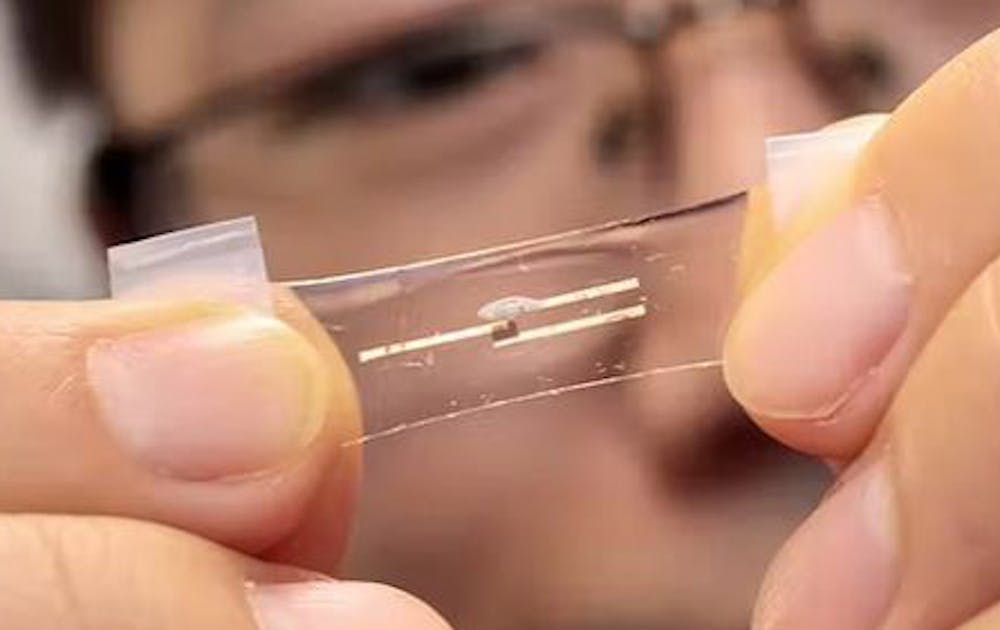
My colleagues and I have developed a flexible, stretchable electronic device that runs machine-learning algorithms to continuously collect and analyze health data directly on the body. The skinlike sticker, developed in my lab at the University of Chicago’s Pritzker School of Molecular Engineering, includes a soft, stretchable computing chip that mimics the human brain.

To create this type of device, we turned to electrically conductive polymers that have been used to build semiconductors and transistors. These polymers are made to be stretchable, like a rubber band. Rather than working like a typical computer chip, though, the chip we’re working with, called a neuromorphic computing chip, functions more like a human brain. It’s able to both store and analyze data.

To test the usefulness of the new device, my colleagues and I used it to analyze electrocardiogram data representing the electrical activity of the human heart. We trained the device to classify ECGs into five categories: healthy and four types of abnormal signals. Even in conditions where the device is repeatedly stretched by movements of the wearer’s body, the device could still accurately classify the heartbeats.

a small rectangle of clear rubber being stretched between two hands  we face in the background
These electronic circuits are flexible and stretchable. UChicago Pritzker Molecular Engineering/John Zich, CC BY-ND

Why it matters

Most of the signals from the human body, such as the electrical activity in the heart recorded by ECG, are typically weak and subtle. Accurately recording these small signals requires direct contact between electronic devices and the human body. This can only be achieved by fabricating electronic devices to be as soft and stretchy as skin. We envision that wearable electronics will play a key role in tracking complex indicators of human health, including body temperature, cardiac activity, levels of oxygen, sugar, metabolites and immune molecules in the blood.

Analyzing large amounts of continuously acquired health data is challenging, however. A single piece of data must be put into the broader perspective of a patient’s full health history, and that is a big task. Cutting-edge machine-learning algorithms that identify patterns in extremely complex data sets are the most promising route to being able to pick out the most important signals of disease.

A typical approach to using machine learning to analyze real-time health data is to transmit the data wirelessly from wearable devices to a computer. But this poses challenges. Sending health data wirelessly is not only slow and consumes extra power, but it also raises privacy concerns. Our research aims to make the AI analysis of health data happen within these skinlike wearable devices, which would minimize the amount of information a device would need to transmit.

The ultimate goal is for this on-the-spot analysis to be able to send patients or health care providers timely alerts, or even one day automatically adjust medication dispensed by other wearable or implanted devices.

What other research is being done

Other research about AI processing health data collected from wearable devices has mainly involved transferring the data to computers running AI algorithms. These projects have demonstrated the potential of AI for extracting useful information from complicated health data.

The recent development of flexible neuromorphic processors is an important step toward running AI data analysis directly on wearable devices, but these flexible processors lack skinlike stretchability and softness, which makes it difficult to build them into wearable devices. In contrast, our device has the skinlike properties necessary for a wearable health monitor.

What’s next

Moving forward, researchers are likely to extend this type of AI analysis integrated in wearable devices to other types of health conditions and diseases. My lab is planning to improve our device, both to better integrate the device’s components and expand the types of machine-learning algorithms it can be used with.

Our work is a good starting point for creating devices that build artificial intelligence into wearable electronics – devices that could help people live longer and healthier lives.The Conversation

Sihong Wang, Assistant Professor of Molecular Engineering, University of Chicago Pritzker School of Molecular Engineering

This article is republished from The Conversation under a Creative Commons license. Read the original article.

Powerful linear accelerator begins smashing atoms – 2 scientists on the team explain how it could reveal rare forms of matter


A new particle accelerator at Michigan State University is set to discover thousands of never-before-seen isotopes. Facility for Rare Isotope Beams, CC BY-ND
Sean Liddick, Michigan State University and Artemis Spyrou, Michigan State University

Just a few hundred feet from where we are sitting is a large metal chamber devoid of air and draped with the wires needed to control the instruments inside. A beam of particles passes through the interior of the chamber silently at around half the speed of light until it smashes into a solid piece of material, resulting in a burst of rare isotopes.

This is all taking place in the Facility for Rare Isotope Beams, or FRIB, which is operated by Michigan State University for the U.S. Department of Energy Office of Science. Starting in May 2022, national and international teams of scientists converged at Michigan State University and began running scientific experiments at FRIB with the goal of creating, isolating and studying new isotopes. The experiments promised to provide new insights into the fundamental nature of the universe.

We are two professors in nuclear chemistry and nuclear physics who study rare isotopes. Isotopes are, in a sense, different flavors of an element with the same number of protons in their nucleus but different numbers of neutrons.

The accelerator at FRIB started working at low power, but when it finishes ramping up to full strength, it will be the most powerful heavy-ion accelerator on Earth. By accelerating heavy ions – electrically charged atoms of elements – FRIB will allow scientists like us to create and study thousands of never-before-seen isotopes. A community of roughly 1,600 nuclear scientists from all over the world has been waiting for a decade to begin doing science enabled by the new particle accelerator.

The first experiments at FRIB were completed over the summer of 2022. Even though the facility is currently running at only a fraction of its full power, multiple scientific collaborations working at FRIB have already produced and detected about 100 rare isotopes. These early results are helping researchers learn about some of the rarest physics in the universe.

Rare isotopes are radioactive and decay over time as they emit radiation – visible here as the streaks coming from the small piece of uranium in the center.

What is a rare isotope?

It takes incredibly high amounts of energy to produce most isotopes. In nature, heavy rare isotopes are produced during the cataclysmic deaths of massive stars called supernovas or during the merging of two neutron stars.

To the naked eye, two isotopes of any element look and behave the same way – all isotopes of the element mercury would look just like the liquid metal used in old thermometers. However, because the nuclei of isotopes of the same element have different numbers of neutrons, they differ in how long they live, what type of radioactivity they emit and in many other ways.

For example, some isotopes are stable and do not decay or emit radiation, so they are common in the universe. Other isotopes of the very same element can be radioactive so they inevitably decay away as they turn into other elements. Since radioactive isotopes disappear over time, they are relatively rarer.

Not all decay happens at the same rate though. Some radioactive elements – like potassium-40 – emit particles through decay at such a low rate that a small amount of the isotope can last for billions of years. Other, more highly radioactive isotopes like magnesium-38 exist for only a fraction of a second before decaying away into other elements. Short-lived isotopes, by definition, do not survive long and are rare in the universe. So if you want to study them, you have to make them yourself.

A diagram of a large facility.
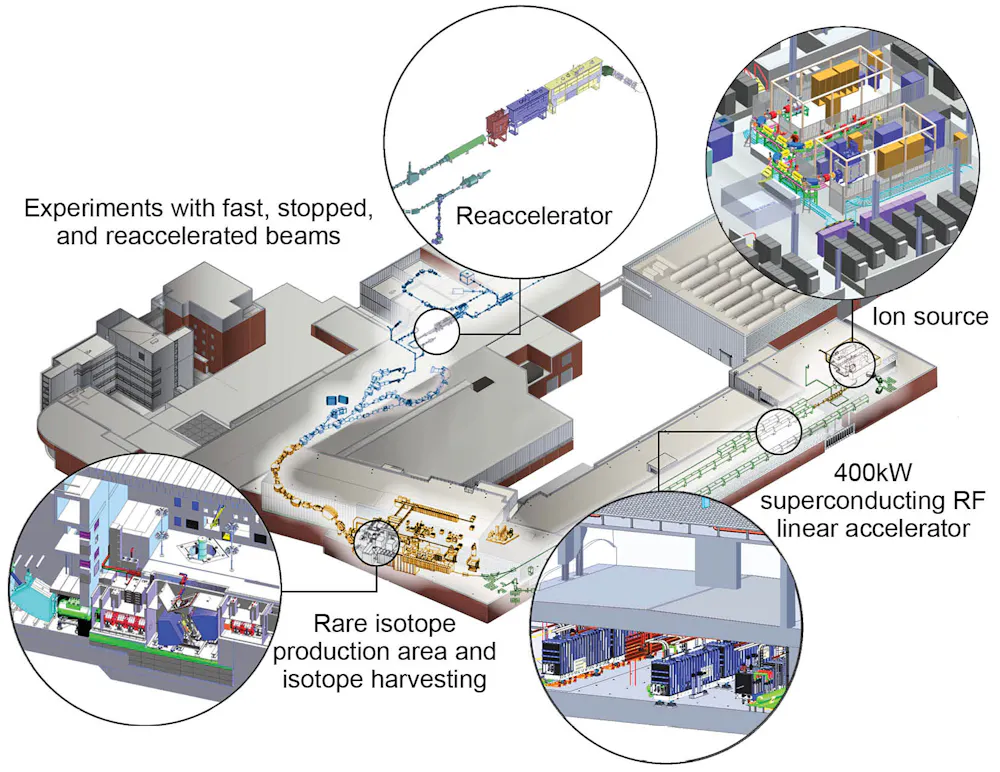
The Facility for Rare Isotope Beams was designed to allow researchers to create rare isotopes and measure them before they decay. Facility for Rare Isotope Beams, CC BY-ND

Creating isotopes in a lab

While only about 250 isotopes naturally occur on Earth, theoretical models predict that about 7,000 isotopes should exist in nature. Scientists have used particle accelerators to produce around 3,000 of these rare isotopes.

A hallway with dozens of large chambers on either side extending into the distance.
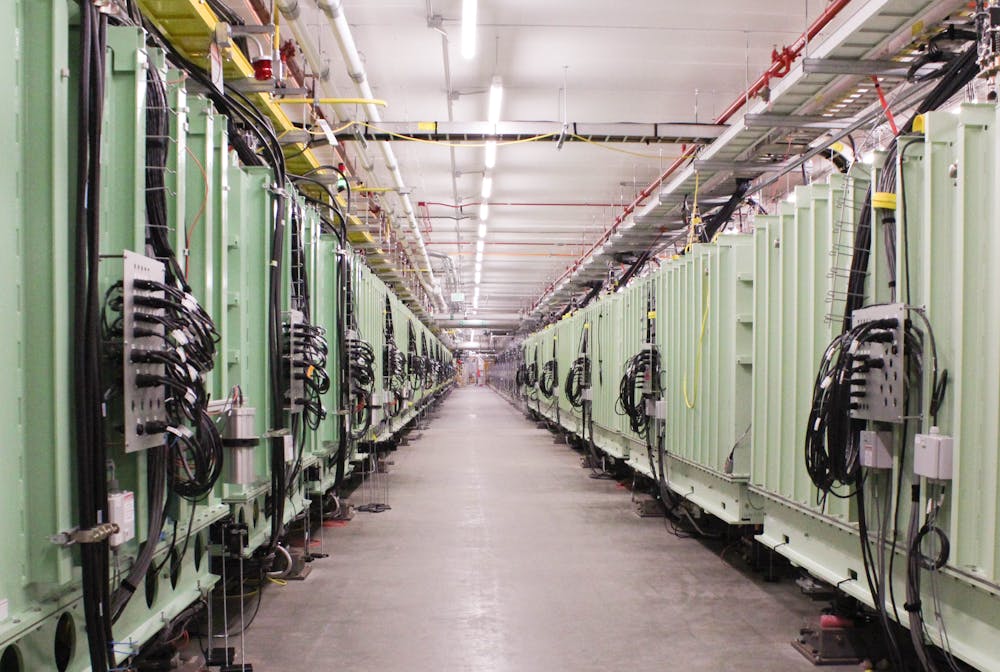
The green-colored chambers use electromagnetic waves to accelerate charged ions to nearly half the speed of light. Facility for Rare Isotope Beams, CC BY-ND

The FRIB accelerator is 1,600 feet long and made of three segments folded in roughly the shape of a paperclip. Within these segments are numerous, extremely cold vacuum chambers that alternatively pull and push the ions using powerful electromagnetic pulses. FRIB can accelerate any naturally occurring isotope – whether it is as light as oxygen or as heavy as uranium – to approximately half the speed of light.

To create radioactive isotopes, you only need to smash this beam of ions into a solid target like a piece of beryllium metal or a rotating disk of carbon.

A complicated machine in a large tube.
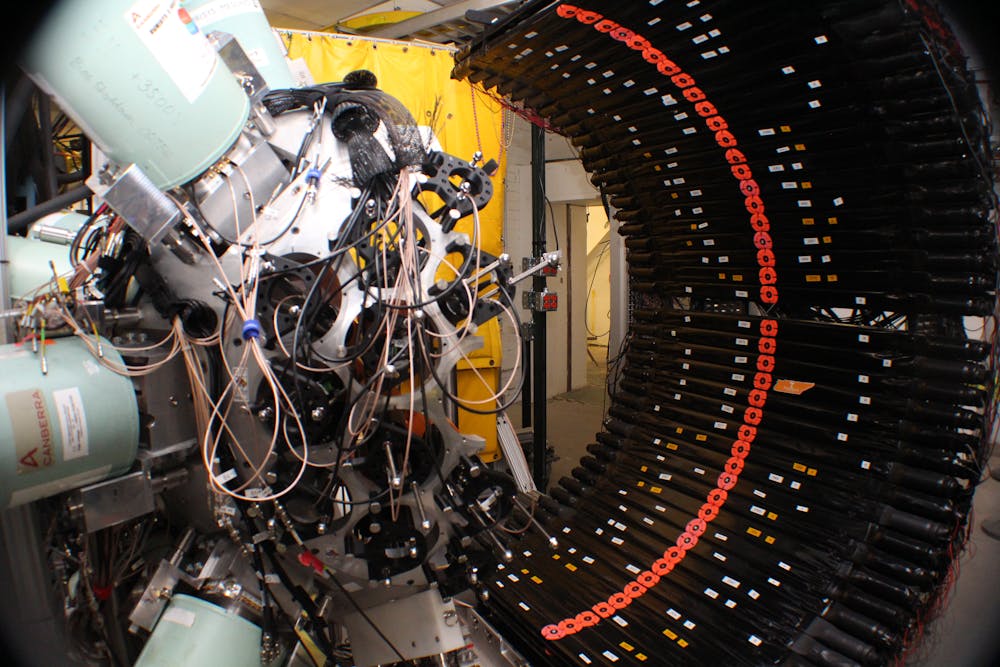
There are many different instruments designed to measure specific attributes of the particles created during experiments at FRIB – like this instrument called FDSi, which is built to measure charged particles, neutrons and photons. Facility for Rare Isotope Beams, CC BY-ND

The impact of the ion beam on the fragmentation target breaks the nucleus of the stable isotope apart and produces many hundreds of rare isotopes simultaneously. To isolate the interesting or new isotopes from the rest, a separator sits between the target and the sensors. Particles with the right momentum and electrical charge will be passed through the separator while the rest are absorbed. Only a subset of the desired isotopes will reach the many instruments built to observe the nature of the particles.

The probability of creating any specific isotope during a single collision can be very small. The odds of creating some of the rarer exotic isotopes can be on the order of 1 in a quadrillion – roughly the same odds as winning back-to-back Mega Millions jackpots. But the powerful beams of ions used by FRIB contain so many ions and produce so many collisions in a single experiment that the team can reasonably expect to find even the rarest of isotopes. According to calculations, FRIB’s accelerator should be able to produce approximately 80% of all theorized isotopes.

The first two FRIB scientific experiments

A multi-institution team led by researchers at Lawrence Berkeley National Laboratory, Oak Ridge National Laboratory (ORNL), University of Tennessee, Knoxville (UTK), Mississippi State University and Florida State University, together with researchers at MSU, began running the first experiment at FRIB on May 9, 2022. The group directed a beam of calcium-48 – a calcium nucleus with 28 neutrons instead of the usual 20 – into a beryllium target at 1 kW of power. Even at one quarter of a percent of the facility’s 400-kW maximum power, approximately 40 different isotopes passed through the separator to the instruments.

The FDSi device recorded the time each ion arrived, what isotope it was and when it decayed away. Using this information, the collaboration deduced the half-lives of the isotopes; the team has already reported on five previously unknown half-lives.

The second FRIB experiment began on June 15, 2022, led by a collaboration of researchers from Lawrence Livermore National Laboratory, ORNL, UTK and MSU. The facility accelerated a beam of selenium-82 and used it to produce rare isotopes of the elements scandium, calcium and potassium. These isotopes are commonly found in neutron stars, and the goal of the experiment was to better understand what type of radioactivity these isotopes emit as they decay. Understanding this process could shed light on how neutron stars lose energy.

The first two FRIB experiments were just the tip of the iceberg of this new facility’s capabilities. Over the coming years, FRIB is set to explore four big questions in nuclear physics: First, what are the properties of atomic nuclei with a large difference between the numbers of protons and neutrons? Second, how are elements formed in the cosmos? Third, do physicists understand the fundamental symmetries of the universe, like why there is more matter than antimatter in the universe? Finally, how can the information from rare isotopes be applied in medicine, industry and national security?

This story was updated to correctly represent the number of neutrons in the nucleus of calcium-48.The Conversation

Sean Liddick, Associate Professor of Chemistry, Michigan State University and Artemis Spyrou, Professor of Nuclear Physics, Michigan State University

This article is republished from The Conversation under a Creative Commons license. Read the original article.